





Mechanical engineering student · Spacecraft deployment, engines and systems software
BTech, Symbiosis Institute of Technology, Pune · 2023–2027
I like problems that survive the first calculation. My main project is VOLLEY, an investigation into controlled spacecraft departure from a retained orbital host. It began with a mechanism. The work since has been about finding out whether the mission earns that mechanism.
Explore VOLLEY · Explore BOLLEY · Engineering record · Contact

Project map, updated 25 October 2026. Current VOLLEY engineering reference: VOLLEY-G5-ACR1. Diagrams describe project roles; technical results are linked to their source configuration.
| Project | What I am investigating | Useful starting point |
|---|---|---|
| VOLLEY | Can provider-hosted control of release velocity, direction and timing earn its installed mass and operating burden? | Current ACR1 package |
| BOLLEY | Does a passive spacecraft interface justify its mass by letting the launcher remove the moving sled and return mechanism? | Selected winding and drive |
| GatewayCX | How should ordinary network applications survive long delays and interrupted Earth–Moon links? | Architecture and executable software evidence |
VOLLEY-G5-ACR1 is the corrected academic configuration: twelve nominal 4 kg 3U surrogates, guided lead-screw feed into a positively restrained transfer cradle, and a captive reusable launch sled. The current computational package supports a modeled 1–3 m/s operating range, with 3 m/s as the principal case. Eight frozen native/STEP states and 154 accepted motion/refinement checks document geometry and sequence under the declared conditions.
The current mass basis is 149.55672 kg CAD dry plus 7 kg electrical/control allowance. This is an academic design with analytical, numerical and geometry evidence. No physical prototype, measured release performance, environmental qualification or provider approval is claimed.
| Edition | Reader route |
|---|---|
| Main | Engineering argument, current source/results and reproduction |
| Labs | Seven-concept feeder trade, alternatives, failed cases and design history |
| Thesis | College report and presentation with their academic evidence |
| Paper | Standalone IEEE-formatted manuscript and source package |
Source/result cutoff: 25 October 2026, ACR1. Original Gen5 16.029 m/s and finite-geometry 12.448 m/s results belong to earlier models and are not current release ratings. FM08-R3 remains the selected mixed 1U/3U subsystem study; its guided lead-screw principle informs ACR1, but its four-cell geometry is a separate configuration. Gen6 mixed-manifest and high-speed research retains its own inputs and limits.
The mission comparison counts installed device mass, release energy and host maneuvers on matched assumptions. It does not establish a product advantage or an approved customer mission. The host supplies navigation, attitude control and permitted maneuvers; the deployer supplies the release condition.
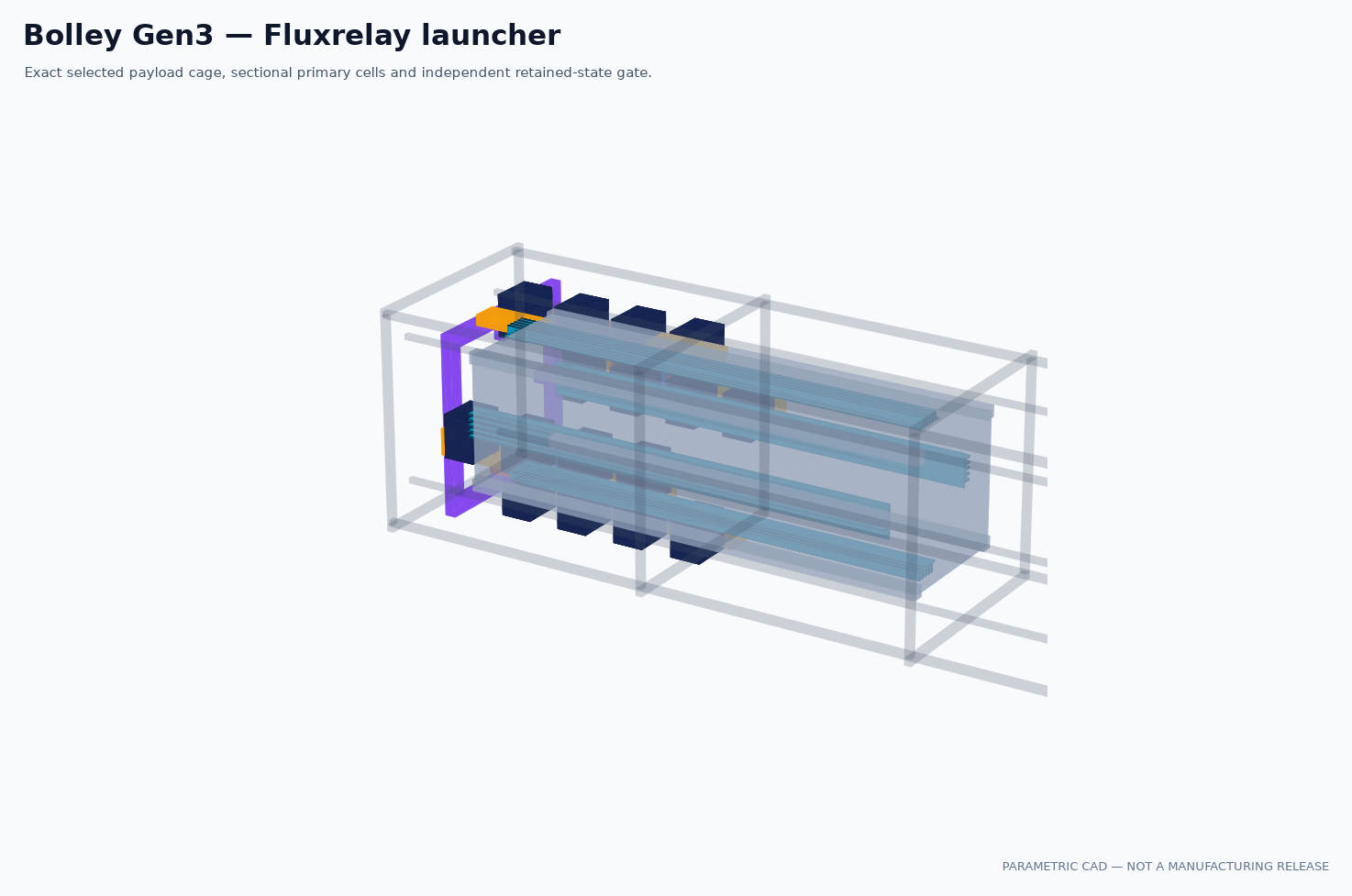
BOLLEY gives the payload a modelled 0.37136 kg passive magnetic/copper interface while retaining the powered windings and electronics on the launcher. The current 4 kg reference duty is 11.8 m/s over 0.90 m at at most 8 g nominal.
The electrical partition moved from four turns at 380 A to twelve turns at 126.667 A. The first twelve-turn fit failed its copper-volume check; the failure is preserved. The later detailed winding passes its nominal CAD bands, while field distribution, hot switching, manufacturing tolerances and installed mass still need closure.
Current BOLLEY evidence · What remains unresolved
| Repository | Reusable capability |
|---|---|
| Pulsed Linear Motor Design Lab | Force, stroke, moving-mass and source-impedance screens |
| Orbital Deployment Trade Study | Two-body release, recoil and phase-drift comparisons |
| Engineering Evidence Toolkit | Source, result, link and artifact consistency checks |
| constraint-floor | Requirement-attributed mass lower bounds |
| parametric-cad-evidence-pipeline | Parameter-to-artifact provenance and build manifests |
| spacecraft-separation-dynamics | Impulse, recoil, tip-off and internal-mass screens |
| gatewaycx-bearer-sdk | Bearer adapters and conformance checks |
| disruption-network-lab | Scheduled-contact delivery experiments |
| scientific-run-registry | Content-addressed computational runs and lineage |
These are narrow tools with explicit assumptions. Software tests and model agreement do not establish hardware performance.
I contributed to Team THRUST's payload-deployment work for the payload that placed second in the SDL Payload Challenge at IREC 2025. I work on Formula Student powertrain, motorcycle engines and ECU calibration, and run Poona Motor Club. Reverse-engineering Powertronic's map format led me to build a dual-map editor.
My engineering work uses Python for numerics and traceability, parametric CAD, field and structural solvers, and independent checks of equations and units. The skills evidence map points to the actual files.
VOLLEY-paper holds the standalone IEEE-formatted Gen5 manuscript and evidence package; it has not been submitted. VOLLEY-thesis holds the standalone college review, report, presentation and local evidence. VOLLEY-lab preserves exploratory and rejected branches.
adityavardhanmishr@gmail.com · LinkedIn · Pune, India