
EEGLAB plugin for intracranial EEG (stereo-EEG and ECoG), with a focus on cortico-cortical evoked potentials (CCEP) from single-pulse electrical stimulation. Every step runs from the EEGLAB menus or from a script.
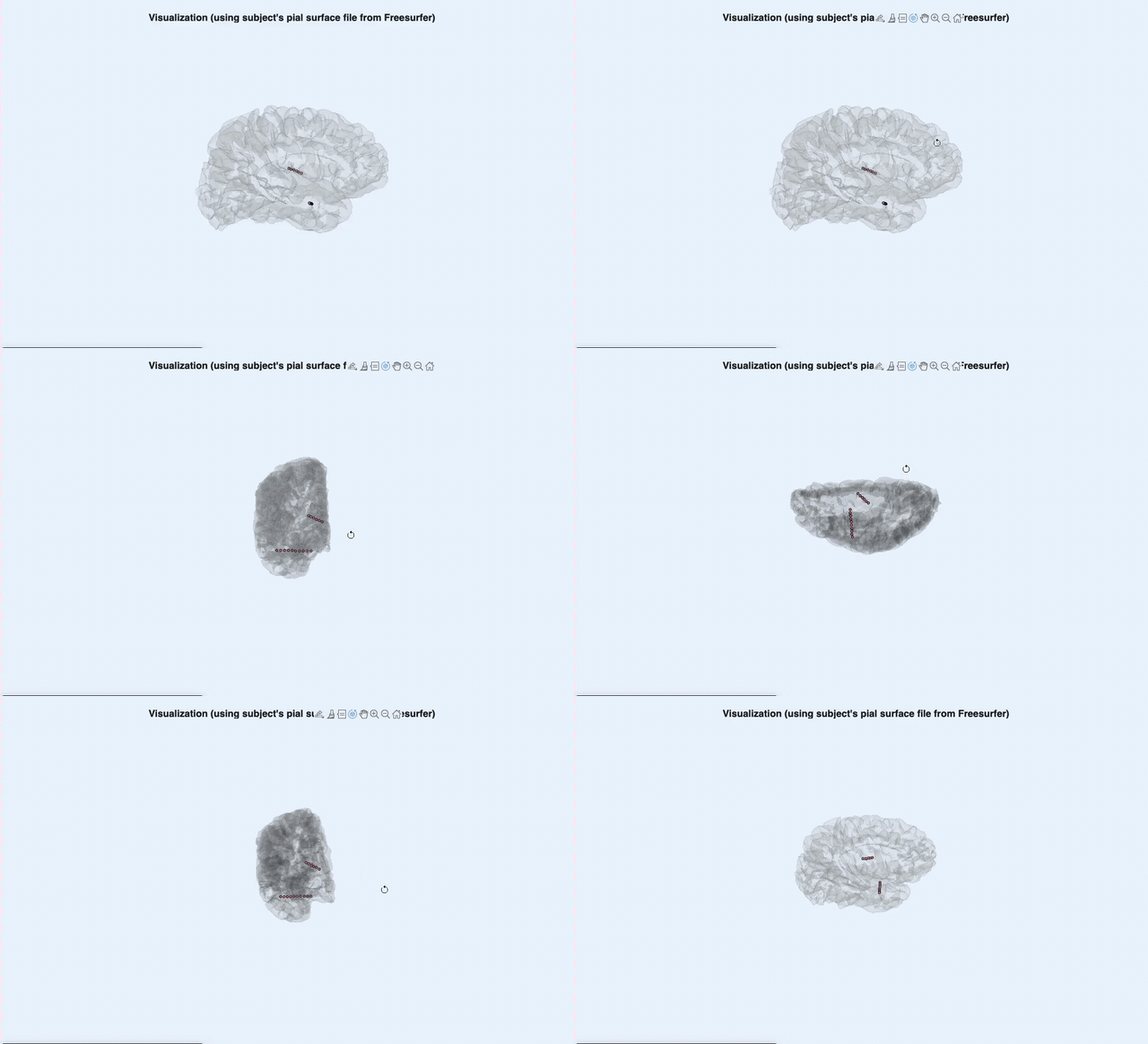
sEEG electrodes on the participant's pial surface
| Step | Menu (iEEGLAB >) | Function |
|---|---|---|
| Read a raw recording of a BIDS dataset (MEF3, BrainVision, EDF, .set): brain channels by default (ECG, EMG and other types on request, for example for BrainBeats), optionally only some stimulation sites, in single precision | Import raw recording | pop_ieeglab_import, ieeglab_import |
| Or import a whole BIDS dataset with EEGLAB (every channel, double precision: fine for short recordings) | File > Import data > From BIDS folder structure | pop_importbids (EEG-BIDS) |
Or FieldTrip epochs (ft_preprocessing output) with their electrode positions |
Import FieldTrip epochs (.mat) | ieeglab_import_fieldtrip |
| Electrode coordinates, events and clinician channel labels from the BIDS files | Load electrode coordinates and events | ieeglab_load |
| The brain every brain figure is drawn on, chosen once (else the one matching the coordinates) | Choose brain surfaces | pop_ieeglab_surfaces |
| Electrodes on the brain | Visualize electrodes | ieeglab_vis_elec |
| Stimulation-artifact blanking, line-noise removal, filtering, epoching, trial and channel rejection, baseline | Preprocess iEEG data | ieeglab_preprocess |
| Re-referencing: CARLA (CCEP), common average, lowest-variance subset, ICA-based, bipolar, custom montages (e.g. a local average) | iEEG re-referencing | pop_ieeglab_reref, ieeglab_montage |
| Power spectrum of each contact; time-frequency power and band power (high-frequency activity by default), on the brain, with a permutation test of each contact's band power against its baseline | Frequency analysis | pop_ieeglab_spectral, ieeglab_spectral, ieeglab_band_stats |
| Average of the epochs of every channel, as an image (channels by time) | Plot average of epochs, every channel (heatmap) | ieeglab_plot_heatmap |
| CRP (sEEG) and N1 (ECoG) with permutation statistics; connectivity matrix | CCEP analysis (N1, CRP, connectivity) | ieeglab_stats_subject |
| One site-contact pair (CRP), the connectivity matrix, values on the brain | Plot CRP of one site and contact; Plot connectivity matrix; Plot electrode values on brain | ieeglab_plot_crp, ieeglab_plot_ccep_matrix, ieeglab_topoplot |
| Export (TSV, JSON, MAT) | Export results | ieeglab_export |
-
Install EEGLAB, which includes the firfilt and EEG-BIDS plugins that iEEGLAB uses. For raw BIDS data also install, from File > Manage EEGLAB extensions, MEF3 (Mayo MEF3 files), bva-io (BrainVision) or Biosig (EDF, BDF).
-
Install iEEGLAB: download the latest release (
iEEGLAB1.3.0.zip) and unzip it intoeeglab/plugins/, or clone this repository there. The EEGLAB extension manager lists 1.3.0 once its list is updated. -
Start EEGLAB and run iEEGLAB > Check installation (
ieeglab_check_install), which lists anything missing. The iEEGLAB menu is right of Help: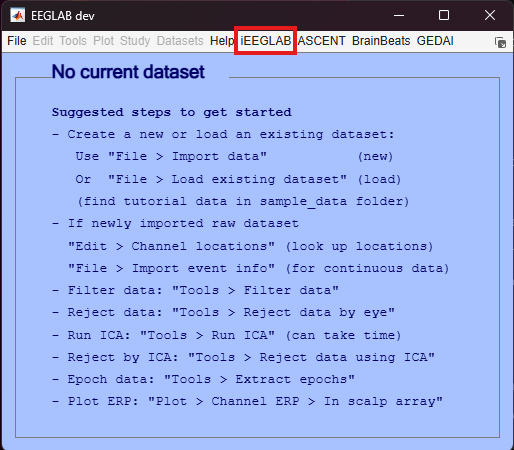
Help > iEEGLAB documentation (also at the bottom of the iEEGLAB menu) opens this page, each tutorial below, the menu-by-menu walkthrough shipped with the plugin, the tutorial script, and the help of each menu's function.
The menus and the tutorials need no MATLAB toolbox. With the Signal Processing Toolbox, CARLA also removes the line noise before ranking the channels.
- Mac with Apple silicon: compile the MEF3 reader. Its C files are in the
MEF3 plugin folder: in MATLAB, go to
eeglab/plugins/MEF3v1.2.2and run the fivemexlines under Building from source. With MATLAB R2025b, Apple's Command Line Tools were enough. - fsaverage (for coordinates in fsaverage or MNI space, such as the ECoG
tutorial): FreeSurfer has it, or get it once from Python with
import mne; mne.datasets.fetch_fsaverage()(if MNE says its download folder does not exist, create it first). iEEGLAB uses onlysurf/lh.pialandsurf/rh.pial.
Step by step through the EEGLAB menus. Each step gives what you should get, the window or figure that opens, and the same step from the command line.
| Tutorial | Data |
|---|---|
| sEEG: cortico-cortical evoked potentials: import, preprocessing, CARLA, CRP, connectivity matrix, time-frequency power, bipolar montage | ds004696 sub-02 |
| ECoG: cortico-cortical evoked potentials: the same on fsaverage, with the common average and the N1 | ds004080 sub-ccepAgeUMCU02 |
| FieldTrip tutorial data: common average of the grids, bipolar depth leads, high-frequency activity, against FieldTrip | FieldTrip's SubjectUCI29 |
| Re-referencing compared: six schemes against the published CRP | ds004696 sub-02, full recording |
| CARLA on its authors' data: the recording of their Figure 5, against the common average | ds004977 sub-1, run 2 |
The first two run on small extracts of public recordings that ship with the
plugin, at their native sampling rate (2048 Hz), each in one folder: the EEGLAB
.set file next to its BIDS sidecar files (electrodes.tsv, channels.tsv,
events.tsv). Each step also gives the numbers for the full recording,
downloaded from OpenNeuro.
| Folder | Data | Source |
|---|---|---|
tutorial/seeg |
sEEG, 17 contacts, 3 stimulation sites, 34 pulses, pial surfaces | OpenNeuro ds004696 sub-02 (Ojeda Valencia et al., 2023) |
tutorial/ecog |
ECoG, 20 contacts, 3 stimulation sites, 30 pulses | OpenNeuro ds004080 sub-ccepAgeUMCU02 (van Blooijs et al., 2023) |
ieeglab_tutorial.m
runs the analysis of both extracts in about a minute. Results repeat exactly
from run to run: the permutation tests and CARLA's bootstrap use a fixed random
seed.
The sEEG tutorial extract from the command line:
eeglab
tut = fullfile(fileparts(which('eegplugin_ieeglab')), 'tutorial', 'seeg');
EEG = pop_loadset('filename', 'sub-02_ses-ieeg01_task-ccep_run-01_ieeg.set', 'filepath', tut);
EEG = ieeglab_load(EEG, struct('event_field', 'electrical_stimulation_site'));
EEG = pop_ieeglab_surfaces(EEG, 'surf_files', ieeglab_brain_surfaces(EEG));
EEG = ieeglab_preprocess(EEG, struct('apply_blank', true, 'apply_notch', true, 'notch', [60 120 180], ...
    'apply_epoch', true, 'epoch_window', [-1000 1000], 'reject_trials', true, ...
    'remove_rare_cond', true, 'min_trials', 5, 'remove_no_coords', true, ...
    'remove_bad_channels', true, 'apply_baseline', true, 'baseline_period', [-500 -50]));
EEG = pop_ieeglab_reref(EEG, 'method', 'carla');
EEG = ieeglab_stats_subject(EEG, struct('run_n1', false, 'run_crp', true, 'run_matrix', true, 'matrix_source', 'crp'));
ieeglab_plot_crp(EEG, 'RA3-RA4', 'RA10');      % one site-contact pair
pop_ieeglab_ccep_matrix(EEG, 'response');      % connectivity matrix
pop_ieeglab_topoplot(EEG, 'in_degree');        % in-degree on the brain
ieeglab_export(EEG, 'results_seeg');
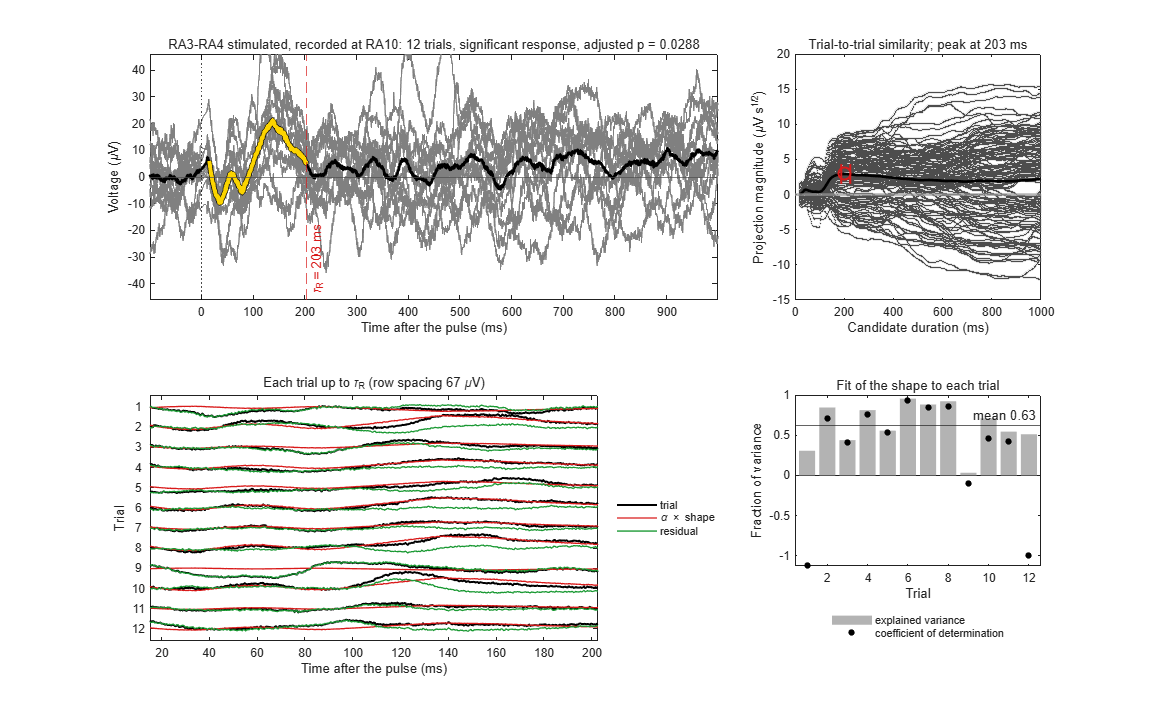
CRP of RA10 for stimulation at RA3-RA4: the trials and their average up to the response duration (yellow), the trial-to-trial similarity, each trial with the fitted shape, and the fit per trial.
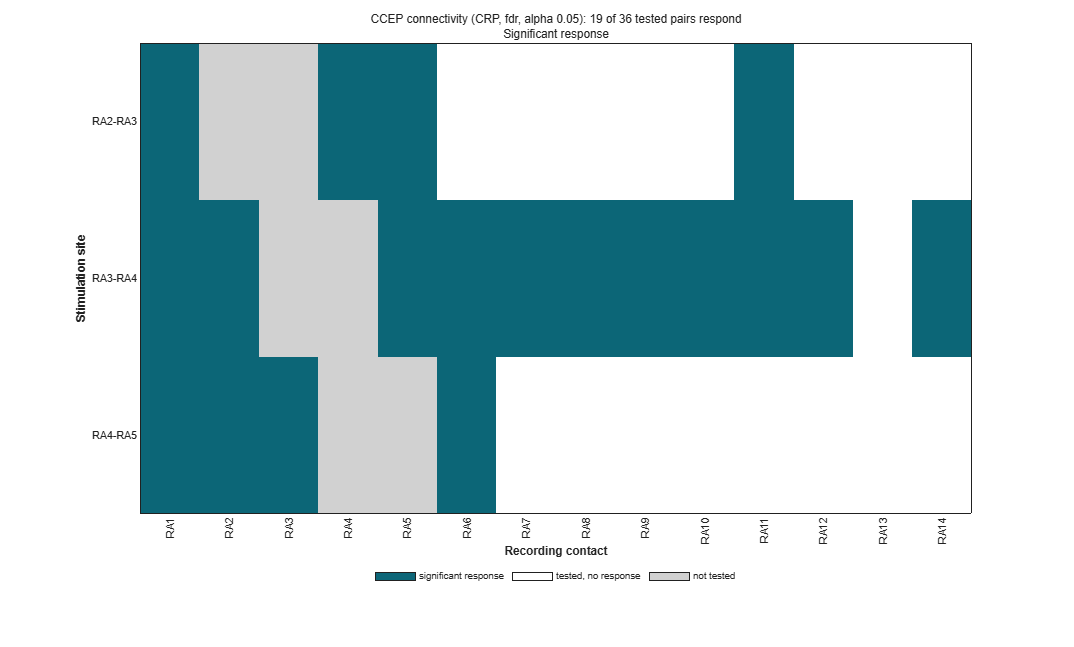
Connectivity matrix: 3 stimulation sites (rows) by 14 contacts (columns).
Both work on any iEEG dataset, with or without stimulation. iEEG
re-referencing offers what the data allow: on continuous data the common
average, ICA, bipolar and custom montages. On stimulation (CCEP) data, CARLA
and the lowest-variance subset are offered after segmentation, and the common
average and ICA wait for the epochs too, where each pulse's stimulated pair is
known and left out. Preprocess iEEG data does not re-reference: when it
removed a baseline, iEEG re-referencing removes it again afterwards, which for
CARLA and the common average gives the same result as re-referencing before the
baseline (ieeglab_preprocess with apply_car, for scripts). The
lowest-variance subset can choose other contacts after a baseline, and warns.
A bipolar montage also gives the same result before or after preprocessing,
except inside the blanked artifact window (its default interpolation is not
linear) and for the line-noise fit, which estimates the mains frequency from
all channels together.
Bipolar in iEEGLAB > iEEG re-referencing subtracts from each contact the next
one on its lead (RA1-RA2 = RA1 - RA2), as FieldTrip does for depth electrodes
(Stolk et al., 2018); A'1 is on lead A', not A. Bad contacts are not paired, a
missing contact leaves a gap, and on grids and strips two contacts farther
apart than twice their lead's median spacing are not paired (the end of one grid
row and the start of the next). Depth leads pair every consecutive contact, gaps
between groups of contacts included. On CCEP data a channel that uses a stimulated
contact counts as stimulated, whatever its name. A custom montage is a table,
one row per new channel: positive (a contact), negative (one contact,
several for a local average separated by spaces or commas, or n/a) and an
optional name, in a .tsv or .csv file; a FieldTrip montage (labelold,
labelnew, tra) also works.
iEEGLAB > Frequency analysis gives the power spectrum of each contact
(continuous or epoched data), or, on epoched data, time-frequency power against
a baseline and the power of a band over time and on the brain. The defaults
follow FieldTrip's intracranial tutorial: Hann windows of 0.2 s, 5 to 200 Hz,
high-frequency activity 70-150 Hz. Only windows that lie entirely inside the
baseline are used for it. On CCEP data each contact's own stimulation epochs
are left out of its average, windows that contain the pulse are left out (grey),
and the spectrum uses only stretches away from the pulses (on epochs, the part
before the pulse). Windows that touch a NaN sample are left out.
From the menu it only draws figures: the dataset is not changed.
The box under the band tests each contact's band power in the band window
against its baseline (ieeglab_band_stats): per epoch and frequency, 10 log10
power averaged over the window minus over the baseline, then the mean over the
band's frequencies; a sign-flip permutation test over epochs (exact with few
epochs), FDR across contacts. The significant contacts are listed, starred, and
alone on the brain, coloured by the tested change.
EEG_bip = pop_ieeglab_reref(EEG, 'method', 'bipolar');
EEG_lap = pop_ieeglab_reref(EEG, 'method', 'montage', 'montage', 'my_montage.tsv');
EEG     = pop_ieeglab_spectral(EEG, 'type', 'spectrum');
EEG     = pop_ieeglab_spectral(EEG, 'type', 'timefreq', 'band', [70 150], ...
              'baseline', [-500 -100], 'norm', 'relchange');
ieeglab_plot_spectral(EEG, EEG.ieeglab.spectral, 'channel', 'RA10');
EEG     = pop_ieeglab_spectral(EEG, 'type', 'timefreq', 'band_window', [100 500], 'stats', true);
EEG.ieeglab.spectral.stats % one row per contact: band_db, t, p, p_adj, significantresults = runtests('tests'); % no figures or dialogsCARLA and CRP are checked against the published implementations
(tests/test_carla_vs_reference.m, tests/test_crp_vs_python.m).
The scripts in validation/ compare iEEGLAB with other tools and with the
authors' code on public data, some from the raw recording and some on the same
input. Each one's help says which, and what to download. The folder is not on
the path: addpath(fullfile(fileparts(which('eegplugin_ieeglab')), 'validation')).
| Script | Against | Data |
|---|---|---|
validate_fieldtrip_uci29 |
FieldTrip's intracranial tutorial (Stolk et al., 2018): re-referencing, time-frequency power, high-frequency activity | SubjectUCI29 |
validate_crp_scripts |
The CRP authors' code (Miller et al., 2023) | their sample data (OSF) |
validate_erdetect_ds004080 |
ER-detect (van den Boom et al., 2025), N1 | ds004080, one run (sub-ccepAgeUMCU02) |
validate_icaref_michelmann |
The ICA re-referencing authors' script (Michelmann et al., 2018) | SubjectUCI29 depth leads, and simulated data |
validate_car_huang_ds004977 |
The CARLA authors' common average (Huang et al., 2024) | ds004977 sub-1 run-02 (public samples: site RMO8-RMO9 only) |
validate_carla_huang_ds004977 |
The CARLA authors' code (Huang et al., 2024), on the site of their Figure 5 | ds004977 sub-1 run-02, site RMO8-RMO9 |
compare_references_ds004696, matched_pipeline_ds004696, split_half_effects_ds004696 |
The published CRP of ds004696 sub-02 (Ojeda Valencia et al., 2023), with each re-referencing scheme and with the paper's own settings (Re-referencing compared) | ds004696 sub-02 |
run_validations runs validate_fieldtrip_uci29, validate_crp_scripts,
validate_erdetect_ds004080, validate_icaref_michelmann and
validate_carla_huang_ds004977 on the data given and writes what they return
to one folder. The figures are drawn in Python (NumPy, SciPy, Matplotlib):
validation/figures/figures_validations.py for FieldTrip, CRP, N1 and CARLA,
from the folder of run_validations, and
validation/figures/figures_rereferencing.py for the re-referencing schemes
and the effect sizes' confidence intervals, from the output folder of
compare_references_ds004696. Each script's first lines say what it reads.
Changes in each version: CHANGELOG.md. Releases: github.com/sccn/iEEGLAB/releases.
Please cite iEEGLAB (CITATION.cff) and the methods you use; each method prints its reference when it runs. Much of the CCEP methodology comes from Dora Hermes and the Multimodal Neuroimaging Lab (github.com/MultimodalNeuroimagingLab).
- de Cheveigné, A. (2020). ZapLine: A simple and effective method to remove power line artifacts. NeuroImage, 207, 116356.
- Huang, H., Ojeda Valencia, G., Gregg, N. M., Osman, G. M., Montoya, M. N., Worrell, G. A., Miller, K. J., & Hermes, D. (2024). CARLA: Adjusted common average referencing for cortico-cortical evoked potential data. Journal of Neuroscience Methods, 407, 110153.
- Klug, M., & Kloosterman, N. A. (2022). Zapline-plus: A Zapline extension for automatic and adaptive removal of frequency-specific noise artifacts in M/EEG. Human Brain Mapping, 43(9), 2743-2758.
- Michelmann, S., Treder, M. S., Griffiths, B., Kerrén, C., Roux, F., Wimber, M., Rollings, D., Sawlani, V., Chelvarajah, R., Gollwitzer, S., Kreiselmeyer, G., Hamer, H., Bowman, H., Staresina, B., & Hanslmayr, S. (2018). Data-driven re-referencing of intracranial EEG based on independent component analysis (ICA). Journal of Neuroscience Methods, 307, 125-137.
- Miller, K. J., Müller, K.-R., Ojeda Valencia, G., Huang, H., Gregg, N. M., Worrell, G. A., & Hermes, D. (2023). Canonical response parameterization: Quantifying the structure of responses to single-pulse intracranial electrical brain stimulation. PLOS Computational Biology, 19(5), e1011105.
- Ojeda Valencia, G., Gregg, N. M., Huang, H., Lundstrom, B. N., Brinkmann, B. H., Pal Attia, T., Van Gompel, J. J., Bernstein, M. A., In, M.-H., Huston, J., III, Worrell, G. A., Miller, K. J., & Hermes, D. (2023). Signatures of electrical stimulation driven network interactions in the human limbic system. Journal of Neuroscience, 43(39), 6697-6711.
- Stolk, A., Griffin, S., van der Meij, R., Dewar, C., Saez, I., Lin, J. J., Piantoni, G., Schoffelen, J.-M., Knight, R. T., & Oostenveld, R. (2018). Integrated analysis of anatomical and electrophysiological human intracranial data. Nature Protocols, 13(7), 1699-1723.
- van Blooijs, D., Leijten, F. S. S., van Rijen, P. C., Meijer, H. G. E., & Huiskamp, G. J. M. (2018). Evoked directional network characteristics of epileptogenic tissue derived from single pulse electrical stimulation. Human Brain Mapping, 39(11), 4611-4622.
- van Blooijs, D., van den Boom, M. A., van der Aar, J. F., Huiskamp, G. M., Castegnaro, G., Demuru, M., Zweiphenning, W. J. E. M., van Eijsden, P., Miller, K. J., Leijten, F. S. S., & Hermes, D. (2023). Developmental trajectory of transmission speed in the human brain. Nature Neuroscience, 26(4), 537-541.
- van den Boom, M. A., Gregg, N. M., Ojeda Valencia, G., Lundstrom, B. N., Miller, K. J., van Blooijs, D., Huiskamp, G. J. M., Leijten, F. S. S., Worrell, G. A., & Hermes, D. (2025). ER-detect: A pipeline for robust detection of early evoked responses in BIDS-iEEG electrical stimulation data. Journal of Neuroscience Methods, 418, 110389.
GPL-3.0-or-later. See LICENSE.