





Python bindings for GxHash, a blazingly fast and robust non-cryptographic hashing algorithm.
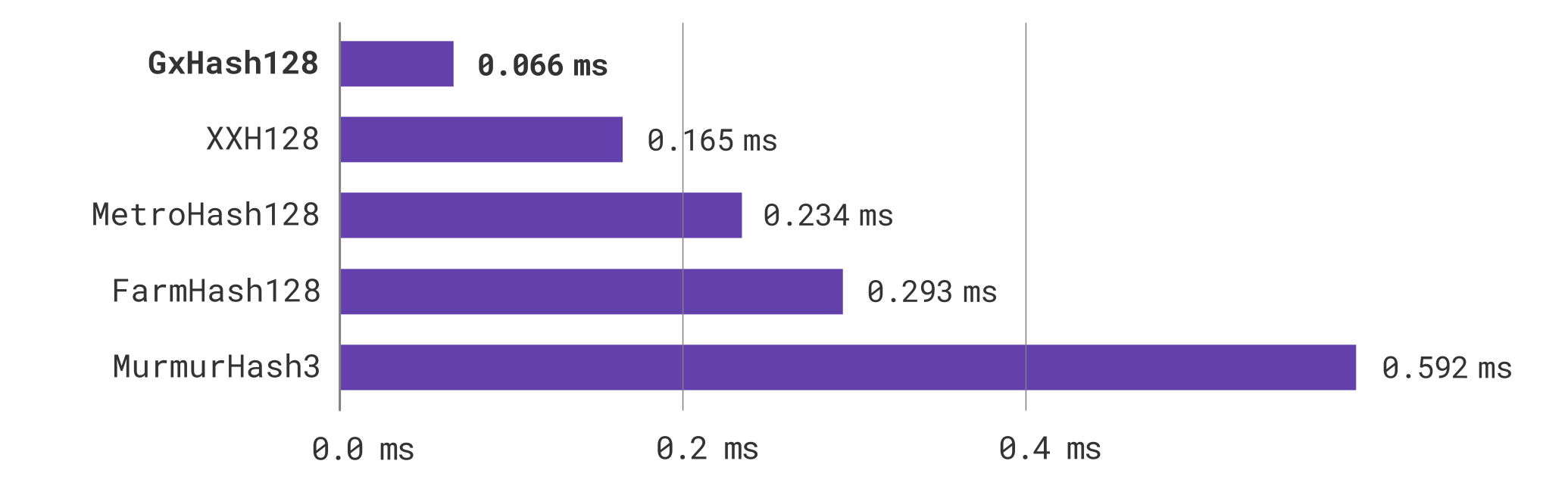
Hashing a 4 MiB payload
- Fastest non-cryptographic hash algorithm of its class1.
- 100x faster than MD5 and up to 3x faster than xxHash on larger payloads.
- Support for async hashing with multithreaded parallelism for non-blocking applications.
- Provides a performant, drop-in replacement for the built-in hashlib module.
- Guaranteed stable hashes across all supported platforms.
- Passes all SMHasher tests and produces high-quality, hardware-accelerated 32/64/128-bit hashes.
- Fully-typed, clean API with uncompromising strict-mode conformance across all major type checkers.
- Pure Rust backend with zero additional Python runtime overhead.
- Zero-copy data access across the FFI boundary via the buffer protocol.
- SIMD-accelerated hexdigest encoding with SSSE3/NEON intrinsics.
- Zero-dependency installations on all platforms supported by maturin and puccinialin.
gxhash is available on PyPI and can be installed via pip.
pip install gxhashFor the best throughput, you can allow gxhash to use wider registers by installing with the MATURIN_PEP517_ARGS variable.
Warning
This is only possible on systems that support VAES and AVX2 instruction sets. Running on unsupported hardware will result in an illegal instruction error at runtime.
MATURIN_PEP517_ARGS="--features hybrid" pip install gxhashBy default, gxhash attempts to detect and use your system's vectorisation features. You can manually control this by setting the specific RUSTFLAGS for your machine. For x64 systems, the minimum required features are aes and ssse3.
RUSTFLAGS="-C target-feature=+aes,+ssse3" pip install gxhashFor ARM64 systems, the minimum required features are aes and neon.
RUSTFLAGS="-C target-feature=+aes,+neon" pip install gxhashgxhash compiles with a pinned nightly toolchain. If you are restricted to a minimum Rust version, you can override the default toolchain with the RUSTUP_TOOLCHAIN variable.
Note
The hybrid feature cannot be used alongside stable Rust.
RUSTUP_TOOLCHAIN="1.83.0" pip install gxhashgxhash is well supported across a wide range of platforms, thanks in part to maturin, and more specifically puccinialin. Therefore, gxhash supports all platforms that maturin and puccinialin support. gxhash is also actively tested on the following platforms:
- Ubuntu 24.04 x64
- Ubuntu 24.04 ARM64
- macOS 26 x64
- macOS 15 ARM64
- Windows Server 2025 x64
- Windows 11 ARM64
Hashing bytes.
from gxhash import GxHash32

def main() -> None:
    gxhash = GxHash32(seed=0)
    result = gxhash.hash(b"Hello, world!")

if __name__ == "__main__":
    main()
Hashing bytes asynchronously.
Important
As with Python's hashlib, callers must not mutate the input buffer during a hash operation.
from asyncio import run
from gxhash import GxHash128

async def main() -> None:
    gxhash = GxHash128(seed=0)
    result = await gxhash.hash_async(b"Hello, world!")

if __name__ == "__main__":
    run(main())
As a drop-in replacement for hashlib, hash computations are deferred and only computed when digest or hexdigest is called
Warning
GxHash is not an incremental hasher, and all inputs provided to the update method will be accumulated internally. This can lead to an unexpected increase in memory usage if you are expecting streaming behaviour.
from gxhash.hashlib import gxhash128

def main() -> None:
    hasher = gxhash128(data=b"Hello, world!", seed=0)
    result = hasher.hexdigest()

if __name__ == "__main__":
main()Read the CONTRIBUTING.md docs for development setup and guidelines.
Footnotes
-
Highest throughput across every payload size, compared against non-cryptographic hash algorithms that pass the SMHasher quality tests. ↩